Thailand
Breadcrumb navigation
FonesVisuas
Disease Risk Prediction from a Single Blood Draw


Enabling a Shift Towards Predictive and Connected Care
Healthcare is undergoing a fundamental transformation. Rising chronic disease burdens, ageing populations, and increasing cost pressures are driving the need for more sustainable and proactive models of care.
NEC Smart Healthcare addresses these challenges by integrating predictive insights with connected care delivery, supporting healthcare providers in moving from reactive treatment to preventive, data-driven healthcare.
-
Predict Before Disease Develops
Non-communicable diseases often develop silently over time, with warning signs appearing only after significant progression. Earlier visibility into potential health risks can create valuable opportunities for preventive action and lifestyle intervention.
A New Approach to Health Risk Assessment
Healthcare systems today face increasing pressure from chronic diseases and aging populations. Traditional approaches focus on diagnosis and treatment after symptoms appear, limiting opportunities for early intervention.
FonesVisuas supports a new direction in healthcare by providing visibility into both future disease risks and current health indicators from a single blood sample. Through advanced proteomics, data analytics and predictive modelling, it transforms complex biological data into clear, actionable insights that support informed healthcare decisions and proactive health management.
-
Analyze ~7,000+ Blood Proteins.
FonesVisuas analyzes 7,000+ types of blood proteins from a single sample to assess the likelihood of developing major health conditions, including dementia and cardiovascular diseases, before symptoms appear.
Understand Future Health Risks.
Using advanced protein measurement, data analysis, and simulation technologies, the solution visualises current health status and potential disease risks in a clear and structured format. These insights support more informed decision-making and enable personalised recommendations to encourage proactive health management.
Disease Risks Prediction Test
The test uses technology to analyze 7,000+ types of blood proteins, providing a clear visualization of future disease risk and the current state of your body.
Predicting Future Diseases
Dementia (including Alzhimer) is the number one cause of needing long-term care.
Risk of developing the disease in 20 years for under aged 65, and in 5 and 20 years for ages 65 and above.
It is estimated that in the near future, approximately one in five elderly people in Japan will develop dementia.*1 When dementia develops, cognitive functions such as memory and judgment decline, making it difficult to carry out daily life as before. In fact, it is the leading cause of needing long-term care among people aged 65 and over.*2 Lifestyle habits such as diet and sleep are also involved in the development of dementia, and those suffering from lifestyle-related diseases are said to be at high risk.*3
- *1Toshiharu Ninomiya: Special Research Project of the Ministry of Health, Labour and Welfare (2014)
- *22018 White Paper on Aging Society (Full Version) (Cabinet Office)
- *3Gill Livingston, et al.: Lancet, 396:413-446 (2020)
Severe damage can result from Cardiovascular Disease.
Risk of developing the disease in 4 years*
Cardiovascular Disease and stroke are among the leading causes of death and can cause serious damage to the heart and brain. Once they occur, they can significantly impair daily life and may lead to a need for long-term care. In particular, studies have shown that stroke has a high recurrence rate of 50% within 10 years of onset*. Factors contributing to the development of myocardial infarction and stroke include high blood pressure, obesity, alcohol consumption, and smoking, and are closely related to lifestyle.
- *HATA, J. et al.: J. Neurol.Neurosurg.Psychiat,. 76: 368-372 (2005)
Prostate Cancer is the most common cancer in men.
Risk of developing the disease in 5 years for Men aged 45+*1.
The incidence increases with age, and the rate rises sharply after age 50. Compared to other types of cancer, it often progresses relatively slowly, and if detected early and treated appropriately, it is considered one of the cancers with a good prognosis. However, it can metastasize to other organs, and treatment may not always be effective.
- *1Statistics from the National Cancer Center
Chronic Kidney Disease is the condition that often goes unnoticed and can easily become severe.
Risk of developing the disease in 4 years.
In Japan, it is estimated that one in eight adults has chronic kidney disease (CKD)*1, and it is being called a new national disease. It has been reported that developing the disease increases the risk of stroke and myocardial infarction*2. In the early stages, there are few noticeable symptoms, and in many cases, people do not realize they have developed the disease and leave it untreated, leading to severe complications. If it progresses to "chronic renal failure," treatments that are physically and financially burdensome, such as hemodialysis or kidney transplantation, may be necessary.
- *1Evidence-based CKD treatment guidelines 2023
- *2New developments in the cardiorenal relationship Journal of the Japanese Society of Internal Medicine Vol. 106 No. 5
Lung Cancer is the leading cause of death among cancers.
Risk of developing the disease in 5 years.
Lung cancer is the leading cause of cancer death in Japan and the third leading cause of new cancer cases. It is particularly common in elderly men and may present with symptoms such as cough and bloody sputum, but there are no specific symptoms that distinguish it from other diseases. The main risk factors are impaired lung function due to smoking and asbestos exposure*1, and some studies have shown that smokers have approximately four times the risk of developing lung cancer*2. Even non-smokers may be at increased risk due to passive smoking.
- *1National Cancer Center Cancer Information Service: Lung Cancer Prevention and Screening
- *2Wakai K, et al.: Jpn J Clin Oncol, 36(5):309-324 (2009)
Current Health Status
- Liver Fat
- Glucose Tolerance
- Alcohol Impact
- Cardiorespiratory Fitness
(VO2 Max) - Visceral Fat
- Resting Energy Rate
Liver Fat leads to Hepatitis and Cirrhosis
When there is an excessive amount of fat in the liver, it is called "fatty liver," which impairs liver function and can cause fatigue, lethargy, and loss of appetite. It can also lead to serious illnesses such as hepatitis and cirrhosis*. However, the liver is often called a "silent organ" because symptoms are often not noticeable even when it is diseased, so caution is necessary.
- *Ministry of Health, Labour and Welfare e-Health Net: Fatty Liver
Glucose Tolerance is closely related to Diabetes
Glucose tolerance refers to the ability to suppress the rise in blood sugar levels. If glucose tolerance persists, the risk of developing diabetes increases, as does the progression of arteriosclerosis, making one more susceptible to stroke and ischemic heart disease*. Generally, glucose tolerance is measured by an oral glucose tolerance test, in which a beverage containing 75g of glucose is consumed after fasting for 8-12 hours, followed by multiple blood draws within 2 hours. However, with FonesVisuas, only a small amount of blood is needed in a single draw, and no prior dietary restrictions are required.
- *Ministry of Health, Labour and Welfare e-Health Net: Diabetes
Measuring Alcohol Impact gives a chance to re-evaluate drinking habits.
This test determines whether your physical condition corresponds to "drinking an average of 7 or more drinks per week*1," rather than the actual amount you consume. The WHO (World Health Organization) warns that excessive alcohol consumption can cause more than 200 diseases and disorders, including liver disease, cardiovascular disease, type 2 diabetes, and dementia*2.
- *1One drink here is approximately 0.8 bottles of beer (5% alcohol, 500mL) or approximately 0.7 go (15% alcohol) of sake.
- *2WHO Fact sheets: Alcohol
Cardiorespiratory Endurance (Maximal Oxygen Uptake) helps to visualise Physical Strength.
Cardiorespiratory endurance refers to "the physical strength and perseverance to sustain a certain level of exercise for an extended period". Several studies have shown that people with high cardiorespiratory endurance have lower incidence and mortality rates of cardiovascular disease. Generally, it is measured through exercises such as cycling, which requires physical exertion, but FonesVisuas can visualize it with just a small blood sample.
High Visceral Fat leads to Heart Disease and Stroke
A condition where there is excessive fat around internal organs and two or more of the following are outside the normal range (blood pressure, blood sugar, and serum lipids) is called "metabolic syndrome," and it is said to increase the risk of heart disease and stroke. Even people who appear thin with a BMI of less than 25 should be careful, as they may have hidden obesity due to excessive visceral fat.
Resting Energy Rate gives insights on food intake and exercise levels
Resting metabolic rate refers to the energy consumed while at rest (quietly resting), and it provides clues to understanding the energy needed from food (required calorie intake) and the energy needed to be expended through exercise (required exercise amount). Our bodies obtain energy from food and consume it through breathing, walking, and exercise. Accurately assessing this "balance of supply and demand" is important for promoting health.
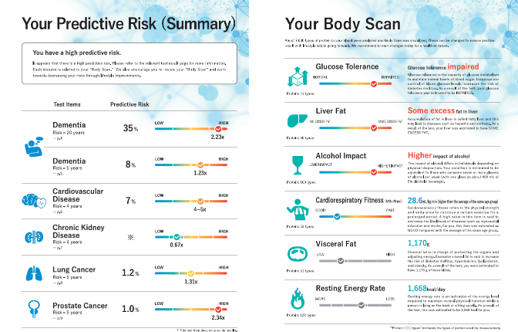
How FonesVisuas Works
FonesVisuas is designed as a simple, scalable process that integrates into existing clinical workflows.
A single blood sample is collected and analyzed for 7,000+ types of proteins. These proteins are processed through advanced analytical by big data models to assess patterns linked to future disease development.
The results are translated into a structured report that presents individual risk profiles, allowing doctors to interpret and act on the insights.

Receive a consultation and proceed with a blood sample collection at participating hospitals or clinics.

Receive a personalized report with insights into current health indicators and potential future disease risks, along with a consultation with a doctor.

Use these insights to make informed lifestyle changes that are best suited to personal needs.
FonesVisuas Proteomics Testing is now available at
And leading Longevity and Wellness Clinics
-
Part of NEC Smart Healthcare
FonesVisuas forms part of NEC’s Smart Healthcare portfolio, contributing a predictive intelligence layer that complements broader healthcare solutions.
While platforms such as CrossCare focus on and service delivery, FonesVisuas extends this capability by providing forward-looking health risk insights.
Together, these solutions support a more integrated approach to healthcare, connecting predictive risk with care delivery and intervention.